

In case you missed it… recent highlights from NCSL in Dialogue, talk2learn’s online community for national education debate:

Download a pdf version of talk2learn highlights: issue 1a (136kb, 1 page)
Download a pdf version of talk2learn highlights: issue 1b (220kb, 1 page)
If you are not yet a member of talk2learn, find out how to join
John Dunford, General Secretary of the Association of School and College Leaders (ASCL) used his time in a talk2learn hotseat to set out the ASCL‘s ’10 Steps for the Future of School Leadership’.
School leaders from all over the country discussed how they had responded to the new school meal guidelines.
John Dunford, General Secretary of the Association of School and College Leaders (ASCL) used his time in a talk2learn hotseat to set out the ASCL‘s ’10 Steps for the Future of School Leadership’.
Ten steps for the future of school leadership
1. Believe in the power and purpose of learning.
2. Want the best for all the young people in their area.
3. Command authority, but use that authority wisely.
4. Share and foster leadership.
5. Build and sustain a learning community.
6. Practise intelligent accountability.
7. Balance short and long term goals.
8. Renew themselves.
9. Work closely with governors.
10. Communicate clearly and consistently.
talk2learn members were invited by John to comment on the steps. A very lively debate ensued with some members continuing to make contributions despite the discussion being declared ‘closed’!
These steps clearly have much value.
Dunford was taken to task by school bursars who felt that their leadership potential had been overlooked by the association’s recommendations as well as by their own schools. "These steps clearly have much value," said one bursar. "However, I feel that they are directed at senior management teachers and not bursars/school business managers. Can someone explain how bursars can be included and therefore feel a part of the overall teaching and learning and progress of schools?" Dunford responded that the 10 steps referred as much to bursars as to teaching staff. Dunford also offered advice to several bursars who were struggling to break into the school leadership team: "try putting a paper to the head on a broad development theme and ask him/her if you can come to a leadership team meeting to discuss it. That might open the door for you when the others realise how much you have to contribute."
One school leader agreed with the step build and sustain a learning community, commenting that it was at odds with her own experience of a school in challenging circumstances being ‘turned round’ by a new head and six staff from his previous school – "what happens to the school they left behind" asked another contributor? Dunford commented that, "to be effective, change has to be sustainable and that means leaders that are there for the long haul, building and sustaining a learning community of all pupils and staff".
To be effective, change has to be sustainable.
Another theme of the discussion was managing the relentless pace of change. Dunford advocated prioritising changes, maybe putting things on hold and certainly putting some things in the bin whilst "trying to hold onto the school’s own priorities as well as implementing the government policies that seem most important".
A National Professional Qualification for Headship (NPQH) candidate strongly agreed with step 4, share and foster leadership, causing Dunford to reflect on his own practice as a head of delegating new developments in school to middle managers, rather than "the usual suspects on the leadership team". Dunford also commented that "lack of delegation is the key to a nervous breakdown!"
School leaders from all over the country discussed how they had responded to the new school meal guidelines.
One contributor described how tasting sessions had been successful in encouraging pupils, parents and staff to tuck into the new term’s healthier menus but others lamented that banning burgers and prohibiting pizza in favour of salads and fruit appears to have come at a price, with reported lost canteen takings, harassed canteen staff and disgruntled children.
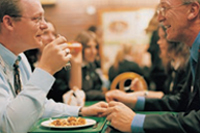
"We have also committed to buy local foods wherever possible and we get our meat from the local butcher, veg from the local farmer."
A headteacher shared his experience in setting up a SNAG (Schools Nutrition Action Group) – including staff, pupils, parents, governors and the school nurse – to find the right recipe for success. "We have also committed to buy local foods wherever possible and we get our meat from the local butcher, veg from the local farmer," she said. "There has been a cost but as the quality of food has gone up sales have also grown."
In contrast, another contributor described the changes in her secondary school canteen as ‘mayhem’ remarking that "more staff are needed to be able to facilitate the change but staffing hours are based on the income they take in… the students are bringing packed lunches so the canteen takings are down which will result in the hours of kitchen staff being cut."