Programme structure
How is the course taught?
CSBM has been designed to enable you to develop your professional competence and ways in which you learn and continue to learn. Participants progress to assessment over a period of 8 to 12 months. Their progression is supported by:
- a protected internet environment in which they debate issues and learn from other SBMs
- group based expert facilitators
- face-to-face sessions (residential for national programmes)
- seven computer-based units/modules
- school-based action research and development projects
- reference guides to independent research material
And what can you expect from the CSBM?
You will start the course as a member of a small group of SBMs and receive individual support from the expert facilitator assigned to that group. You will take responsibility for your own learning and will become involved in debate and study within your own group and the national population of individuals studying the CSBM.
How long will it take you?
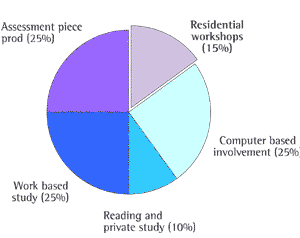
The course can be completed in 8 to 12 months – it all depends on your personal circumstances and learning style. The course is broken down as follows:
How is the programme structured?
The CSBM is structured as follows and is underpinned by continual practitioner and study skills development.
The five phases of the programme
- Induction phase 1: This phase is conducted online and prepares participants for the Introduction phase 2.
- Introduction phase 2: This phase provides participants with in-depth guidance on the programme, its requirements and the competences that underpin the programme.
- Core modules phase 3: This is usually a two-day session, residential for the national programmes and non residential for local programmes, focused on the SBM competencies. Three core modules are studied at this phase – financial management, human resources management and risk management.
- Core modules plus (+) phase 4: This is usually a two-day session, residential for the national programmes and non residential for local programmes, focused on the SBM competencies and covers four further modules – facilities management, office systems management, ICT management and sustainable development.
- Concluding phase 5: This is a one and a half day event, residential for the national programmes and non residential for local programmes, in which participants provide evidence of their competence as an SBM.
What is the general content of the course modules?
- Financial management: school budgeting, accounting, auditing, financial reporting, cash management, investment, debt management and purchasing procedures.
- HR management: staff development, labour relations, collective bargaining, payroll procedures.
- IT management: ICT provision, maintenance and development of integrated systems, management information systems, facilities management, facility planning and construction.
- Facilities management: estate management, vehicles and transport, catering services, supply and fixed asset management.
- Risk management: health and safety, risk and loss prevention procedures.
- Office systems management: organisation and management models, operational design, evaluation of business services, communications.
- Sustainable development: planning for a better school environment, education for sustainable development (ESD), environmental impact of DCSF and its partners, environmental impact of the education estate, local and global partner activity.