

In case you missed it… recent highlights from NCSL in Dialogue, talk2learn’s online community for national education debate:

Download a pdf version of talk2learn highlights: issue 16a (164kb, 1 page)
Download a pdf version of talk2learn highlights: issue 16b (208kb, 1 page)
Download an audio version of issue 16a (1.7Mb, 4:10 mins) and issue 16b (1.6Mb, 4 mins)
Subscribe to the podcast to receive future updates automatically
If you are not yet a member of talk2learn, find out more about how to join
‘Learning zones’ trialling new approaches to teaching, outdoor classrooms bringing students closer to the natural world and the possibilities for knowledge sharing afforded by Web 2.0…these were just some of the innovations highlighted by school leaders contemplating the opportunities offered by Building Schools for the Future (BSF) in a recent talk2learn debate.
Challenging the negative image of vocational courses and finding the funding and physical space to provide them were among the issues raised in a recent talk2learn hotseat discussion about the raising of the education leaving age.
‘Learning zones’ trialling new approaches to teaching, outdoor classrooms bringing students closer to the natural world and the possibilities for knowledge sharing afforded by Web 2.0…these were just some of the innovations highlighted by school leaders contemplating the opportunities offered by Building Schools for the Future (BSF) in a recent talk2learn debate.
C hildren are thriving on being outdoors and learning from ‘doing’.. .
Many contributors argued that BSF should be seized on as a chance to rethink education – not just to create state-of-the-art classrooms, fixtures and fittings. Before embarking on designing new buildings, school leaders should analyse what they want education to achieve in future, education consultant Stan Terry warned. "There is plenty of evidence in the business world that change projects often fail because not enough thought has gone in before the project is started," he said.
Sara Pelling, a school business manager in a Burnley secondary, felt schools need a better understanding not only of what children want to learn but also how they want to learn it. "Young people today learn so quickly in spaces outside of school but we are not always giving them the support or skills to transfer this learning to other areas."
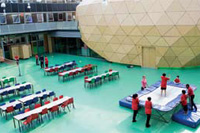
Steve Gater, a secondary headteacher in Newcastle, was one of many contributors to highlight the vital role ICT has to play in providing new approaches to learning. Higher education is also looking to capitalise on young people’s use of new technologies and schools should do the same, he suggested. "I had a conversation with a pro vice-chancellor of a local university in which he propounded the virtues of Web 2.0 for better learning. He described the tools that young people are already using themselves for informal learning and, as we know, are often denied within school formal learning programmes because of a widespread lack of knowledge, understanding and skills among the school workforce."
At Assistant Head Steven Maxson’s secondary school in Scunthorpe, they are using BSF as a platform to create a ‘learning zone’ research project. "In this large, fully-equipped space, we will trial a variety of approaches to learning – single year, single subject; mixed year, single subject; mixed year, cross-curricular; single year, crosscurricular – and hope to come to some conclusions."
And showing that innovative thinking doesn’t have to be confined to a school building, Administrator Diane Ball’s small rural primary in
Lancashire has put up an outdoor classroom which is also used for lunchtime activities and by the community. "The children are thriving on being outdoors and learning from ‘doing’," she said. "Our next project is a small pond area which will bring the community, parents and children together to create a wildlife area. The children love the ‘hands on’ approach and the interaction with other adults."
Finally, Cathy Laird, an assistant head in a Suffolk secondary, urged caution. Rather than recreating an ideal that never really existed or going ‘space age’, forward-thinking schools should concentrate on interpersonal and communication skills and the ability to research, receive and reflect on information, she argued. "I want schools to educate youngsters to have the abilities and self-esteem to learn throughout their lives. I don’t think we should be responding to a hypothetical virtual world, the demands of industry or the current skills shortages which will all have changed again in 5, 10, 15 years’ time."
Challenging the negative image of vocational courses and finding the funding and physical space to provide them were among the issues raised in a recent talk2learn hotseat discussion about the raising of the education leaving age.
T he extra two years spent in education will provide something for all – not just academia .
The springboard for the debate was a interview with ‘Sarah’, a Year 6 pupil who will be among the first 16-year-olds affected if the age rises to 18. Nothing less than a complete change of thinking on content and shape of education post-16 is required if the policy is to succeed, according to Deputy Head Helen Stallard. "Vocational qualifications are still seen as inferior and it’s that attitude which needs to change. There are still ghosts of ‘You head for grammar school and academic subjects or do homecraft/woodwork’ but children’s choices are not always dictated by ability," she said.

"The current policy of placing greater emphasis on learning to learn skills and sharing the learning journey is certainly a move in the right direction. But how do we change society’s/employers’ attitudes?" Lorraine Irving, an admin/finance officer in early years in Newcastle, also stressed that children who took the ‘vocational’ option were often classed as ‘second-class citizens’. "If the government is to achieve its aim and equip children with the skills to take them forward, a successful marketing campaign needs to be put in place to remove the stigma and convince children that the extra two years spent in education will provide something for all – not just academia."
Others were concerned about more practical implications of the policy. Karen Sowten, an assistant bursar in Kent, described how her semi-rural secondary school was already bulging at the seams. "Vocational courses are a great idea, though they do need a lot of space and a lot of funding. But introducing them is a must. Where would we be without our plumbers, carpenters, builders etc?"
Andrea Thompson, a bursar in a small rural secondary school in Cumbria, was concerned about the future for some children in rural areas. Vocational qualifications require a higher level of funding not just because of capital equipment and building needs but also because of the smaller teacher-pupil ratios, she said. "I do hope the government will properly recognise this. Funding for so many new initiatives eventually gets ‘integrated’ into the main delegated funding and this does not help a school with small pupil numbers to continue such programmes. "Additional cost pressures in rural schools include transport costs to other providers of specialised vocational subjects such as engineering. This also adds to timetabling pressure as time for travel must be allowed. It constricts a timetable already constrained by small numbers of teaching groups and leads to extra costs."
But new thinking needs to come from others, besides the government, said Keith Rendell, from a technology college in Shropshire. He suggested closer links with business could lighten the load when it came to costly specialist buildings and equipment. "Perhaps there is also the opportunity to remodel the apprenticeship programmes so that the majority of the skills development is achieved in the workplace, thus reducing the financial burden on education."