

In case you missed it… recent highlights from NCSL in Dialogue, talk2learn’s online community for national education debate:

Download a pdf version of talk2learn highlights: issue 9a (148kb, 1 page)
Download a pdf version of talk2learn highlights: issue 9b (212kb, 1 page)
Download an audio version of issue 9a (1.4Mb, 3:34 mins) and issue 9b (1.3Mb, 3:20 mins)
Subscribe to the podcast to receive future updates automatically
If you are not yet a member of talk2learn, find out more about how to join
School leaders voiced their concerns about what they saw as a lack of communication and insufficient support for the new 14–19 agenda in a talk2learn hotseat with Jon Coles, Director of 14–19 Reform at the DfES.
Presenting policies and plans in child-friendly language, running relevant and results-driven school councils and encouraging youngsters to lead classroom learning can persuade pupils to participate in school leadership.
School leaders voiced their concerns about what they saw as a lack of communication and insufficient support for the new 14-19 agenda in a talk2learn hotseat with Jon Coles, Director of 14-19 Reform at the DfES.
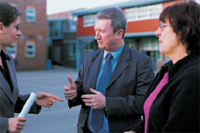
The agenda’s objectives were welcomed but the way it is being rolled out came under fire.
Julie Ricketts, an exams officer in a large Northamptonshire secondary school, said more information was desperately needed.
"As someone who will have to implement the changes to entries etc., I have received very little information so far – just a very brief outline from the National Assessment Agency," she added.
Jon Coles replied that there would be ‘significant’ communication before the first teaching of the new diplomas in autumn 2008 and that exams officers would receive full training.
A lack of guidance on timetabling and other practicalities worried Richard Baker in East Sussex.
"As I see it, all pupils will have the entitlement to all of the specialised diplomas. This means that, within a cluster of schools, they would all have to be provided. We would, therefore, have to accept pupils from other schools without the ability to say no.
"What is going to happen to GCSEs and how will pupils travel between schools and colleges?
"I feel that this is being forced on us, without much thought about how it should be implemented."
What is going to happen to GCSEs and how will pupils travel between schools and colleges?
Jon Coles said there were already working examples of how diplomas can be delivered – and timetabling can work – across a cluster of schools.
"People can still run different numbers of periods, of different lengths, still start and finish at slightly different times and so on, provided that they work to some common principles," he said.
GCSEs would stay, he added, although with the advent of diplomas, the ways in which general qualifications are delivered will need to change. There were also some good models of how transport between schools could work.
Another school leader in Buckinghamshire felt there could be job losses if staff were not able to provide all the required subjects and that all teachers had to be brought ‘on board’.
"However, the new courses will be excellent for the disaffected students and those who wish to pursue a trade. These students currently cause disruption in the classroom and I feel offering them a more appropriate curriculum could reduce exclusion figures," she said.
Jon Coles said a national professional development programme was aimed at supporting teachers, starting with those who need to teach the diplomas first in 2008. There could also be significant implications for the balance of staffing in schools, he added.
Presenting policies and plans in child-friendly language, running relevant and results-driven school councils and encouraging youngsters to lead classroom learning can persuade pupils to participate in school leadership.
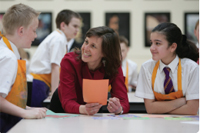
Increased pupil involvement can make a real difference to the way schools are run, according to contributors to a talk2learn discussion led by Dr. Reena Keeble, a headteacher and NCSL Leadership Network Regional Leader in London.
There was widespread support for Dr Keeble’s introduction of a ‘School Book to Make Things Better’, her school’s development plan deliberately written in ‘child-speak’; many contributors thought this idea should be extended to action plans and governor reports.
Participants also agreed that school councils should do more to encourage pupils to contribute good ideas.
Jean Reynolds, a primary deputy head in London, helped set up her school council two years ago:
"Children see that their ideas and concerns are acted upon…there are occasionally suggestions put forward which are outside of our control but this is clearly explained.
"The chef came to a meeting armed with menus after the school council conducted a survey of what the children would like to eat instead of chips. We now have fantastic school lunches, freshly cooked."
One contributor said her secondary school’s council was initially seen as a ‘token gesture’ and soon lost impetus.
Students are more likely to listen to their peers than adults, especially when discussing topics such as stereotypes, race, labelling and prejudice.
"But a rethink has already seen great progress; there has been an impact on teaching and learning preferences and allocation of money-raising to chosen charities."
Wendy Armstrong, a member of her school’s SMT in Northumberland, said all schools in her local network encouraged staff and pupils to exchange lessons and ideas. The school councils meet annually to discuss major concerns or learning opportunities with comments sent to individual schools for action.
Louise Solden, an extended schools coordinator in Leeds, said her school allowed 72 students to take over learning in the classroom for one day as part of a peace and conflict resolution programme.
"Students are more likely to listen to their peers than adults, especially when discussing topics such as stereotypes, race, labelling and prejudice.
"It took six months to set up but all the school considered it to be a good step forward."