

View the full discussion in talk2learn
Download a pdf version of talk2learn highlights: issue 19b (216kb, 1 page)
Download an audio version of issue 19b (1.4Mb, 3:32 mins)
Subscribe to the podcast to receive future updates automatically
If you are not yet a member of talk2learn, find out more about how to join
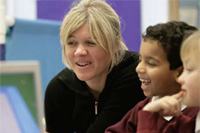
With increasingly diverse pupil populations a reality for many schools, a talk2learn discussion looked at the strategies adopted by leaders for integrating children of migrant families into their classrooms.
Key points raised by contributors included problems with funding when the groups of migrant children are small; difficulties in communicating with parents of migrant children; but also parents and pupils as vital resources for translation and other support.
An influx of pupils from other countries immediately puts pressure on budgets and the extra cash to provide bilingual help in a variety of less common languages is not easy to find, many contributors pointed out.
Shirley Flatt, a bursar at an Essex primary, described how funding cuts – a result of increased demand from other schools for services for migrant families – meant hers now received additional funding for just one hour a week of one-to-one support to supplement its own provision for its small number of migrant children.
"Fortunately one of the parents of each of these pupils speaks good English because, unlike some schools, our numbers are not significant enough for us to provide someone to translate should we have a family that does not speak English at all."
One successful strategy was suggested by Linzi Dearden in Lancashire who said a combination of pooled resources and student help had provided bilingual support to her school’s Polish, Indian, Pakistani and Chinese children.
"By putting the children together within a team, they receive full-day support as opposed to one-to-one and the teaching assistants are employed 30 hours per week. We have also had secondary pupils and college students who are of the same origin doing work experience within the classroom. This has provided a great resource and it’s free!"
Several contributors highlighted the particular difficulties of building relationships with parents of migrant children who do not speak English. One said her school, with 13 different ethnic groups and 24 languages spoken, had invested in both teaching and non-teaching staff, to help Somali and Tamil pupils but also their families.
"The Somali and Tamil parents are our most needy. We have learning support who come from the same background and they are present when we have new families coming in. They take them round the school, give the children an induction in the mother tongue, find them a buddy and liaise with the family to help them settle down. It has really helped both the school and the parents."
Another contributor said his school has put a Polish parent with teaching experience on the payroll to help support some of the 25 per cent of pupils who are eastern European.
"She works 15 hours weekly taking groups of children out of class which gives teachers the opportunity to work with English pupils. We also occasionally ask one of our older Polish pupils who has been with the school for about three years to translate for us if no-one else is available and it can be quite entertaining at times with the translation form Polish to English or vice-versa!"